
Weymouth Resident Lookup Records
One person can appear in several record systems, but each system proves something different. The Weymouth MapGeo property viewer can connect a parcel to its assessment owner, situs address, mailing address, and tax-map reference. It does not identify every person living there. The Secretary's voter-status form is an individual confirmation tool, while the Town Clerk holds the fuller local voter material. MassCourts is the statewide docket gateway, and the Town Clerk or the Massachusetts Registry of Vital Records and Statistics, known as RVRS, handles certificates. Use the source that matches the question, not a loose name match.
| Record | What It Confirms | Where | Access |
|---|---|---|---|
| MapGeo parcel card | Assessment owner, situs, mailing clue, parcel | Weymouth MapGeo | Public viewer |
| Voter record | Individual status or public local fields | Secretary search; Weymouth Town Clerk | Status form or local request |
| Court docket | Party, case, court, status, and events | MassCourts and court clerk | Public portal and terminals |
| Vital certificate | A recorded birth, death, marriage, or event | Town Clerk or RVRS | Request and eligibility rules |
| Historical sources | Former school, directory, obituary, or family context | Library and Historical Society | Digital and appointment access |
Start with an address only when the goal is to identify the assessment owner. Start with a name and date details for the voter-status form. Start with a court department or case number for a docket. A certificate request is the last step when official event proof is needed.
Weymouth Voter Status Details
The Massachusetts voter-status search requires first name, last name, month, day, year of birth, a five-digit residential ZIP code, and an agreement checkbox. It is meant to let an individual check status, not to browse a public name-and-address directory. Use the name as registered, rather than a nickname. If the person moved, the earlier registration ZIP may be the useful one. A recent registration can also take two to three weeks to appear.
For an existing Weymouth voter list or record, contact the Board of Registrars or Town Clerk at Town Hall. Public fields can include name, residence address, party, date of birth, active or inactive status, voter ID, and some registration history. Phone, email, veteran status, permanent absentee status, minor records, confidential voters, and ACP information are withheld. A written request should state the list type, as-of date, preferred format, and ask for the expected redactions and production cost.
The voter-status screen shown here illustrates the required identity fields for an individual check.
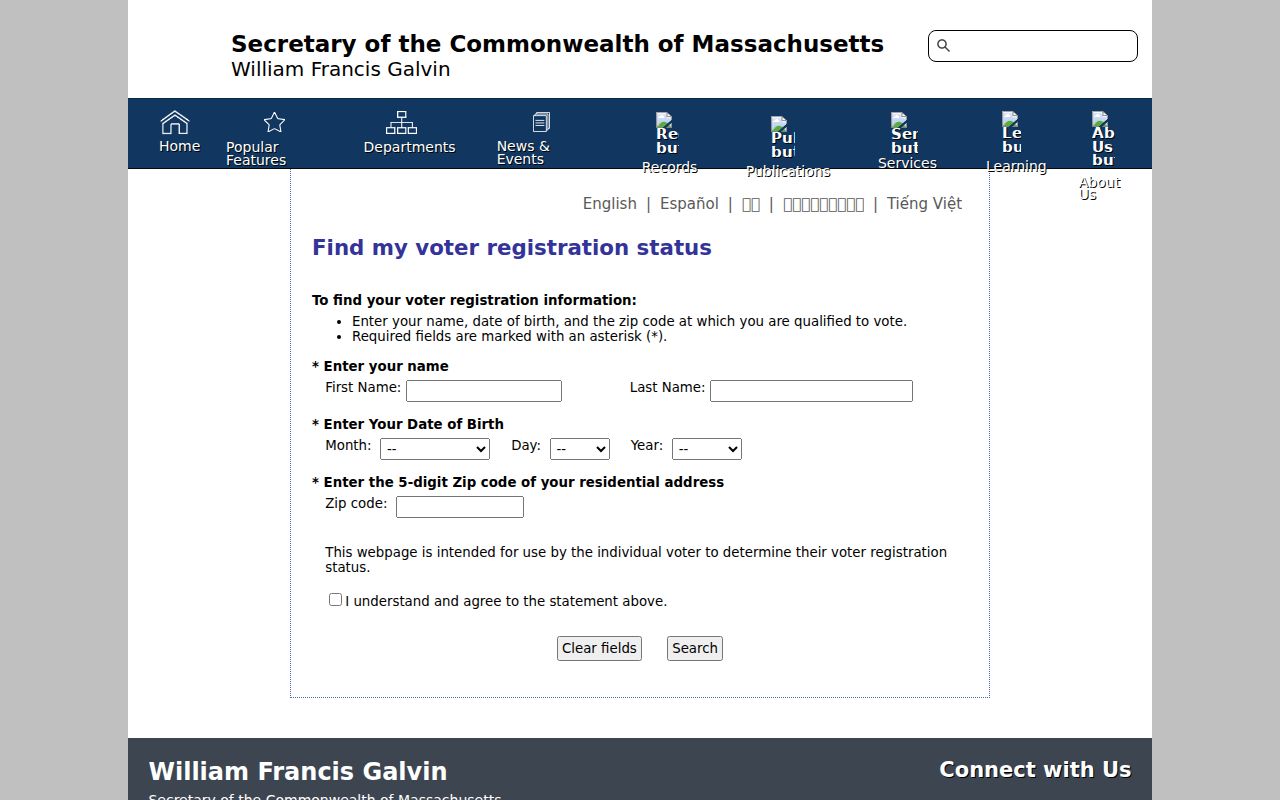
The form's residential ZIP requirement helps distinguish a status check from a broad resident list.
Note: A voter field can confirm a record category, but it does not reveal a ballot choice or establish a person's present household.
Weymouth Court Name Lookup
Massachusetts Trial Court Case Access is the public entry point for dockets. Select a court department first, then its division and, when offered, location. Weymouth matters may be served by Quincy District Court, Norfolk Probate and Family Court in Canton, Norfolk Superior Court in Dedham, or another listed court. On the name tab, civil searching accepts last and first name, with optional middle name and suffix. The portal also offers company name, case type, case status, party type, date ranges, and a result-count control.
Most criminal matters cannot be searched remotely by a broad person name. An exact case number is usually required. If a civil name search does not resolve a same-name problem, use the court division, a middle name, a date range, or the exact case number. The public terminals and the clerk's office can fill gaps in remote access. Juvenile, adoption, sealed, expunged, impounded, abuse-prevention, and other protected categories are not ordinary remote results.
The MassCourts search landing screen is the correct starting point for court docket review.
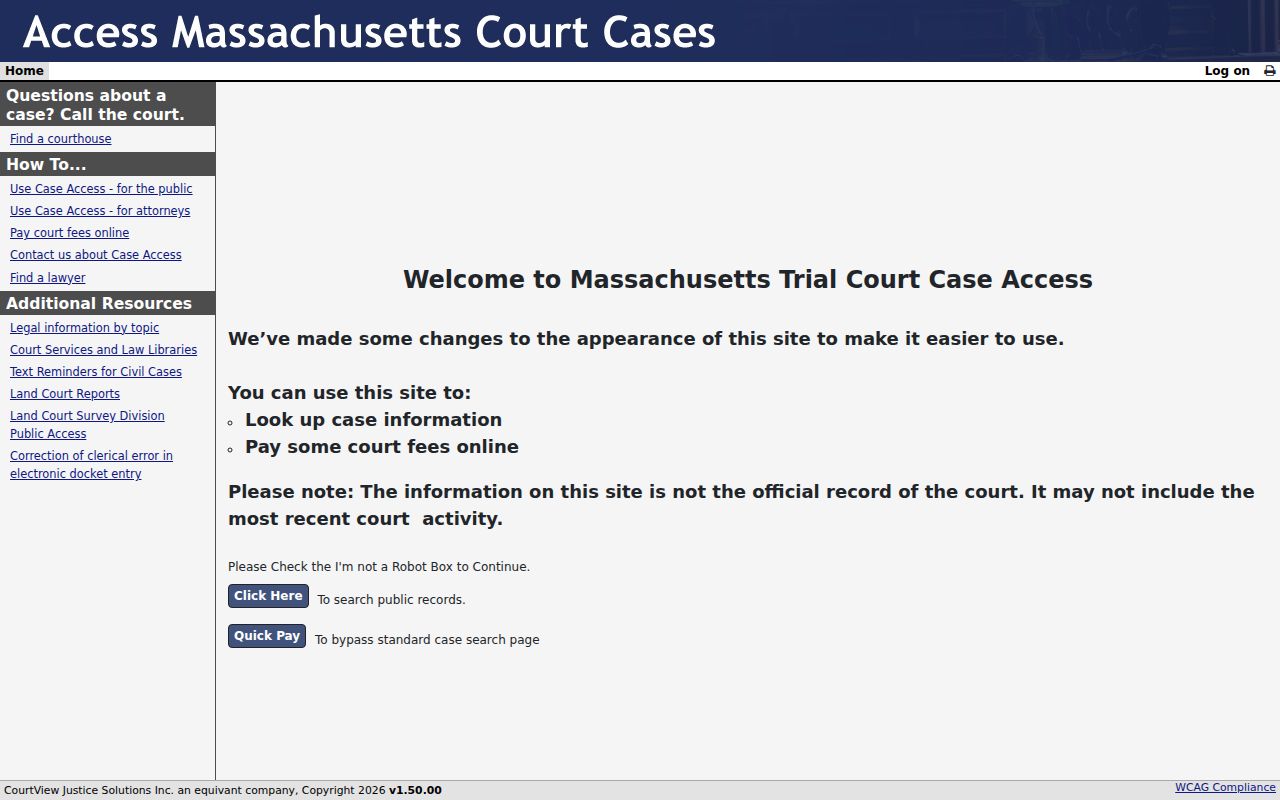
A docket result is a lead, not a substitute for the public file held by the clerk or register.
- Docket
- A court's running case record, including case number, parties, filings, events, and status.
- Index and image
- An index points to a record. An image is the scanned document, which may be restricted even when an index entry is visible.
- Certified copy
- A custodian-issued copy with the certification needed when an official record, rather than a search result, is required.
Weymouth Vital Record Routes
RVRS has no public browseable online index. For a Weymouth event, the Town Clerk can issue qualifying local birth, death, and marriage copies, while RVRS supplies statewide records from 1936 forward. Earlier events may be held by the town where recorded, and 1931 through 1935 records were transferred to the State Archives. A death certificate, marriage certificate, or birth certificate has its own access rules, so an online name result should never be assumed to be available.
Weymouth lists $15 per local copy. RVRS lists $20 in person, $32 by mail, and $42 expedited, with separate VitalChek charges. The RVRS mail form permits up to five searches, calls for identification and payment materials, and covers a ten-year search when an exact town is unknown. Local, mail, in-person, online, historical-research, and public-record-request channels serve different needs. A divorce record remains a Probate and Family Court matter, not an RVRS certificate substitute.
RVRS ordering guidance shows the certificate channels and identification rules for a request.
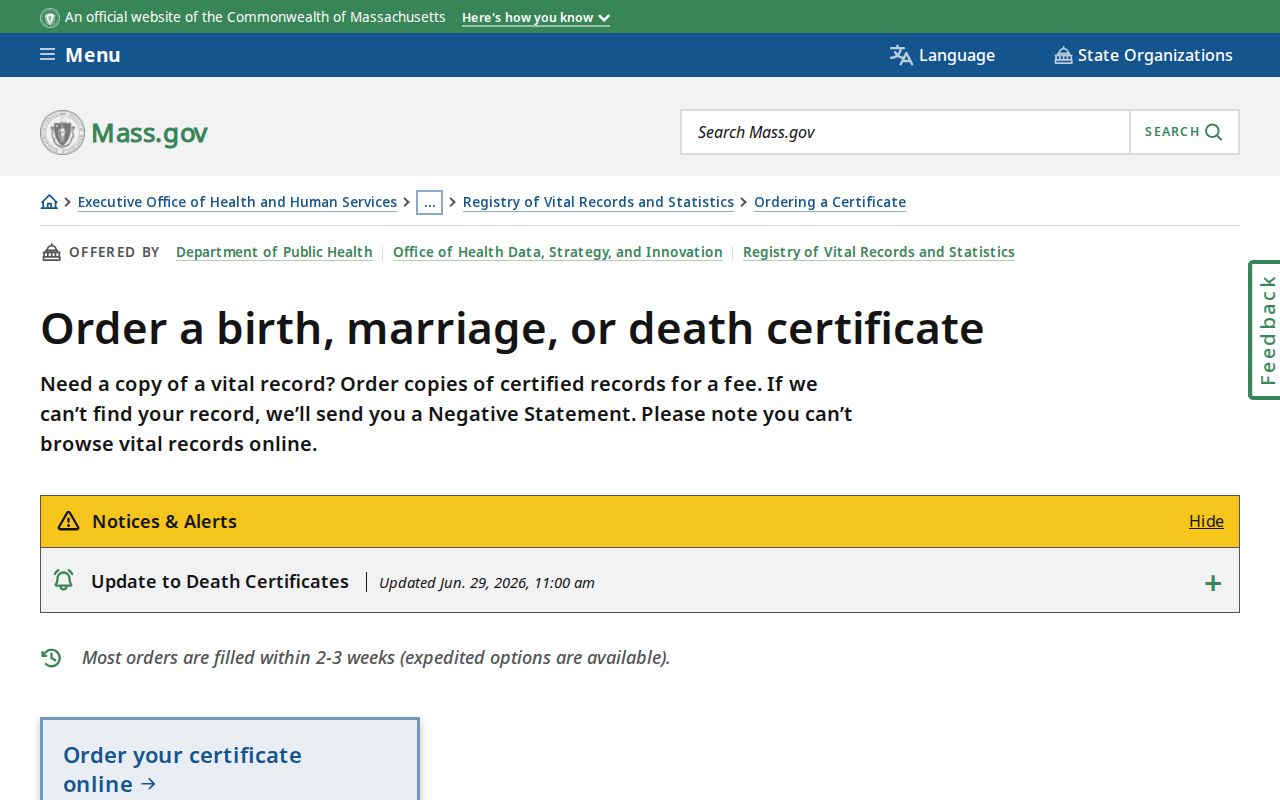
Use the certificate custodian's current instructions, because eligibility and fee rules differ by record and delivery method.
Verifying a Weymouth Resident Match
A careful resident lookup narrows a match in stages. Assessment ownership, voter status, court dockets, and vital events are not interchangeable. The goal is to compare independent details without treating a mailing address, old directory entry, or unconfirmed surname as present residence.
- Locate the name or address in MapGeo and note the situs address, assessment owner, mailing clue, and parcel reference.
- Use the voter-status form only for the individual status question and with the required name, birth date, and residential ZIP.
- Search MassCourts with the correct court selection, then compare party name, case number, court location, case type, status, filing date, and docket events.
- When an event needs proof, request the certificate or official court copy from the custodian and follow its identification or eligibility instructions.
A MassCourts result commonly identifies the party, case number, case type, status, court, filing date, calendar, and docket events. Those fields make better comparison points than a name alone. For an address-wide question, the researched route belongs on the Weymouth streets page, where parcel and deed records are handled by address.
Weymouth Resident Lookup Name Traps
Names in historic and official indexes are not normalized into one perfect identity. The Norfolk Registry says its index follows the instrument as recorded, so misspellings, missing initials, and variant spellings matter. Its research guide recommends a broad surname first, then a first name or middle initial, and allows an asterisk for variants. Search recorded land and registered Land Court separately. Recorded-land material reaches 1793, while the online registered Land Court index begins in 1973.
MapGeo creates a different trap: its owner, situs, and tax mailing fields are assessment clues. A trustee, estate, or organization may appear as owner, and a bill can go to another address. That does not identify an occupant. The Registry's address indexing is strongest for applicable records from 2003, so older work should move from the current parcel reference into grantor and grantee names, plan references, and legal descriptions.
Weymouth Resident Record Requests
When a portal does not provide an existing public record, use the Town's written route. Weymouth directs public-record requests through its NextRequest center, with the Town Clerk designated as Records Access Officer. State law is the Massachusetts Public Records Law, M.G.L. c. 66, § 10. The request should identify the existing record, name or address, relevant date range, and desired format. It cannot require the office to create a new directory or investigate a person.
The usual response period is ten business days. Municipal labor may be charged after two hours, normally capped at $25 per hour, along with allowed copy or postage costs. Vital and police materials have their own exclusions and access paths. A request can also be the fallback for an existing local voter record, a building file, or other municipal record that has no open web index.
Weymouth's public-record request page is shown below for the written-request channel.
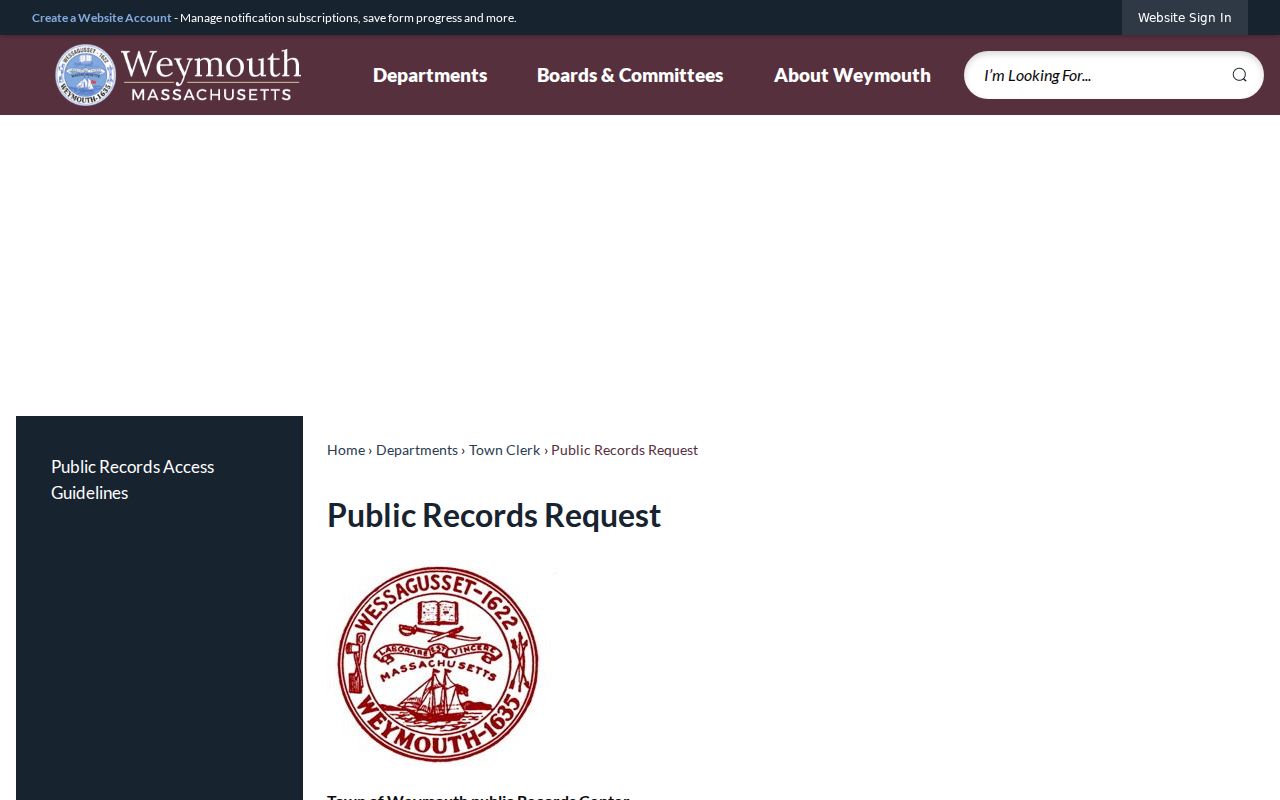
The request route works best when it describes a known record, instead of asking staff to build a person profile.
Weymouth Resident Lookup History
For a former classmate, family connection, or older address, Weymouth's historical collections can add context that current portals cannot. The Library's local-history resources include annual reports from 1850 through 2017, high-school yearbooks from 1914 through 2013, and the Weymouth Gazette for 1867 through 1924 and 1926 through 1928. Originals require an appointment, researcher form, and identification. The Weymouth Historical Society also maintains local genealogy, town-vital, and cemetery material.
Historical sources should be read as dated snapshots. A yearbook places a student in a school year; a directory can place a householder or business at a past address; a newspaper scan may need visual confirmation because OCR can misread names. Pair a historical find with a date, place, and an official record when verification matters.
Note: Historical directories can explain a past connection, but their dated entries do not establish a current Weymouth resident record.
Weymouth Resident Lookup Limits
Massachusetts protects records and fields that a name search cannot override. The Address Confidentiality Program provides substitute-address and mail-forwarding protection for eligible survivors and certain protected health-care providers. Confidential voter data is excluded from ordinary voter files. Court records can be sealed, impounded, juvenile, or otherwise unavailable remotely, and full death-record Social Security numbers have narrower access. A public record request is not a correction request, so report an error directly to the custodian with the record identifier and supporting documents.