
Weymouth Directory Shelf
The Massachusetts State Library lists a substantial, but uneven, Weymouth run. Its holdings begin with 1870 to 1871 and reach selected volumes in 1953. The books are best treated as snapshots. A missing year does not prove a household vanished, and a starred item in the State Library PDF needs to be checked against the catalog legend or the physical volume. The same holding list includes voting lists, which are useful companions but are not city directories.
| Collection | Years | Where Held | Access |
|---|---|---|---|
| Weymouth resident and business directories | 1870 to 1953, selected years | Massachusetts State Library catalog and shelves | Confirm the item and format before a visit |
| Street and house-guide material | 1938 to 1953, selected years | State Library directory holdings | Check the individual volume for its address section |
| Weymouth voting lists | 1896 to 1980, selected years | State Library | Separate municipal-list material, subject to voter rules |
| Digitized local-history companions | Reports 1850 to 2017; yearbooks 1914 to 2013 | Weymouth Historic and Digital Collections | Online collection and library assistance |
The full directory sequence is specific: 1870 to 1871, 1873 to 1874, 1876 to 1877, 1878 to 1879, 1880 to 1881, 1888 to 1889, 1891 to 1892, 1896, 1899, 1902 to 1903, 1905 to 1906, 1907 to 1908, 1911, 1913 to 1914, 1916 to 1917, 1919 to 1920, 1922 to 1923, 1926 to 1927, 1929 to 1930, and 1932 to 1933, plus State Library-starred 1938 to 1939, 1941 to 1942, and 1953 items. Boston Public Library holdings and digitization cover selected 1905 to 1906 through 1932 to 1933 volumes. Catalog access can also lead to selected scans through Library of Congress, DPLA, Internet Archive, and the library versions of FamilySearch or Ancestry.
Note: Record the exact volume year before comparing names, because Weymouth directory publication was not verified as an unbroken annual sequence.
Weymouth Directory Years
The earliest named volume in the catalog descriptions is The Weymouth, Quincy, and Braintree Directory, 1870 to 1871. Later Weymouth resident and business volumes may combine alphabetical residents, businesses, public offices, schools, societies, churches, post offices, a map, and sometimes a house guide. The later house-guide run is especially helpful when the search begins with a number and street instead of a surname.
- 1870 to 1871: the combined Weymouth, Quincy, and Braintree volume gives the starting point for the located directory shelf.
- 1873 to 1933: selected books create the main historical sequence, with gaps that require the nearest available volume.
- 1938 to 1953: the State Library lists selected later items, including selected house-guide material.
Do not assign a publisher name from a later cover to every Weymouth book. The accessible holding list identifies a resident and business directory series, but does not consistently provide a full publisher name for every volume. The title page is the right source for that detail. This small check prevents a catalog note from becoming an unsupported citation.
Weymouth Directory Originals at Tufts
Weymouth Historic and Digital Collections ties the directory search to newspapers, reports, yearbooks, maps, photographs, and finding aids. At Tufts Library, local-history originals are appointment-only. Researchers must review the Special Collections Usage Policy, complete a Researcher Application, and present valid identification. The Reference Desk can be reached at 781-340-5002. Those rules apply to original material, not as a claim that every historical item is online.
The collection’s digitized town reports, yearbooks, and Gazette issues often supply a date between directory volumes. Reports can identify officeholders, committees, and local projects. Yearbooks add class, club, and photograph context. The Gazette can hold a notice, sale, obituary, or civic item that helps confirm the right surname and street.
See the Weymouth Historic and Digital Collection page before planning an original-material visit.
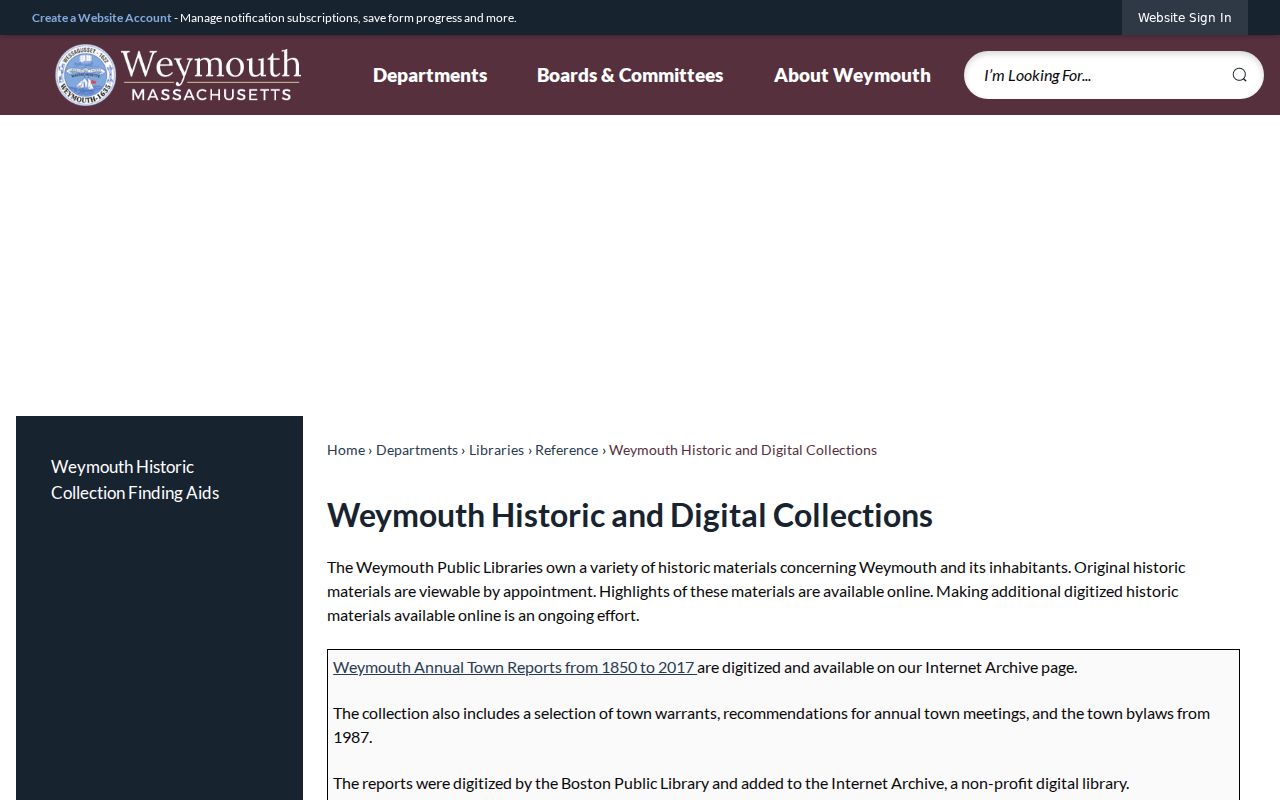
The collection page brings the relevant reports, yearbooks, Gazette runs, and finding aids into one local starting place rather than treating a single directory volume as the whole record.
Reading Weymouth Directory Entries
Read the printed line as a compact record, not a modern profile. An alphabetical entry may give a surname and given name, a spouse or widow notation, a stated trade or firm connection, and a street address. Some volumes add a telephone, a residence abbreviation, or a status mark. A business page can instead name a proprietor, firm, trade, and location. The available fields change by volume, so an absent detail is not evidence that it did not exist.
| Alphabetical entry | Surname, given name, and sometimes spouse or widow notation |
|---|---|
| Trade or firm line | Stated trade, business, or proprietor detail where the book prints one |
| Street address | Number and street, useful for comparison with the house guide |
| Street or house guide | Street and number first, followed by the named household or occupant where printed |
| Institutional matter | Town offices, schools, societies, churches, post offices, maps, or street indexes |
- Criss-cross directory
- An address-ordered section that reverses the alphabetical arrangement, placing street and number before the name where the volume includes it.
- Householder index
- A name or address arrangement intended to connect a household with a listed location, not a complete record of everyone at that location.
- Abbreviation key
- The volume’s printed guide to shortened words. Common examples include h, wid, av, st, rd, sq, P.O., prop, and rem, but the local key controls.
Photograph or transcribe the abbreviation key before taking notes. In different books, r can carry more than one printed meaning. The printed key, not a modern assumption, resolves the mark.
Weymouth Directory by Street
A street or house guide is the historical reverse route. Start with the street spelling and number in the guide, copy the listed name exactly, then return to the alphabetical section for any additional printed details. Compare the same address in the nearest available book, not only in the next calendar year. The books are selected runs and a single gap can span several years.
Village labels matter. Catalogs and old material may use Town of Weymouth, East Weymouth, South Weymouth, North Weymouth, Weymouth Landing, or Weymouth Centre. A historical street can also appear beside an older place name. For current parcel and deed work, the Weymouth street directory route uses MapGeo and Norfolk land records rather than trying to make a historical house guide answer a current question.
Weymouth Directory Gaps and Gazette Clues
The digitized Weymouth Gazette covers 1867 to 1924 and 1926 to 1928. It can bridge a directory gap with announcements, obituaries, property-sale notices, legal notices, business advertisements, and civic reports. Search an exact surname and street first, then try a spouse name, firm name, village, or a short street form. Newspaper OCR can misread New England names, so confirm a promising result in the scan image.
Town reports, available from 1850 to 2017, add a different official series. They may place a surname in a committee, public work, memorial, or town-office context. That is useful evidence of time and place, but not proof that the person resided at a particular address.
Note: Use a Gazette result to form a date range, then test it against the closest directory, deed, voter-list, census, or cemetery record.
Trace Weymouth Directory Households
Family-history work is strongest when the researcher captures each volume’s exact spelling, address, and relationship notation before drawing a conclusion. The federal census is publicly available through 1950 under the 72-year release rule. Its household composition can test whether a directory line reflects one person, a couple, or a larger household. Directories between census years can narrow the period of a move.
- Find the surname in the closest available Weymouth volume and copy its wording, street number, and any spouse or widow notation.
- Check the street or house guide when that volume contains one, then compare nearby household names without assuming a relationship.
- Repeat in the nearest earlier and later directory volumes, including surname initials and variant spellings.
- Pair the dated entries with the appropriate federal census return through 1950 to test household composition and the address context.
- Use a Gazette notice, cemetery record, probate file, or deed only as a dated cross-check for the historical trail.
A name can disappear because of a move, death, marriage, a changed household form, a different spelling, or a publication gap. It does not establish one answer on its own. The Historical Society’s cemetery and family material is a useful next stop when the dated record trail turns into an end-of-life question.
Weymouth Directory Research at Holbrook
The Weymouth Historical Society keeps local genealogy, cemetery, family, and town-history materials at Holbrook Homestead, 238 Park Avenue in South Weymouth. It is open Wednesdays from 9 a.m. to 1 p.m., excluding holidays, and by appointment. Admission is free; its phone is 781-340-1022. The Society’s cemetery pages, plot maps, grave codes, veteran identifications, and town-vital resources can help distinguish families who share a surname.
Old North Burial Ground is described by the Town as Weymouth’s first cemetery, a local historical marker that can add a final place to a long family trail. Cemetery material should be paired with the death record, obituary, or probate evidence available for the same person. A grave code or plot map is useful historical evidence, not a substitute for confirming identity.
Visit the Historical Society’s Weymouth research resources for its hours and local-history contact details.
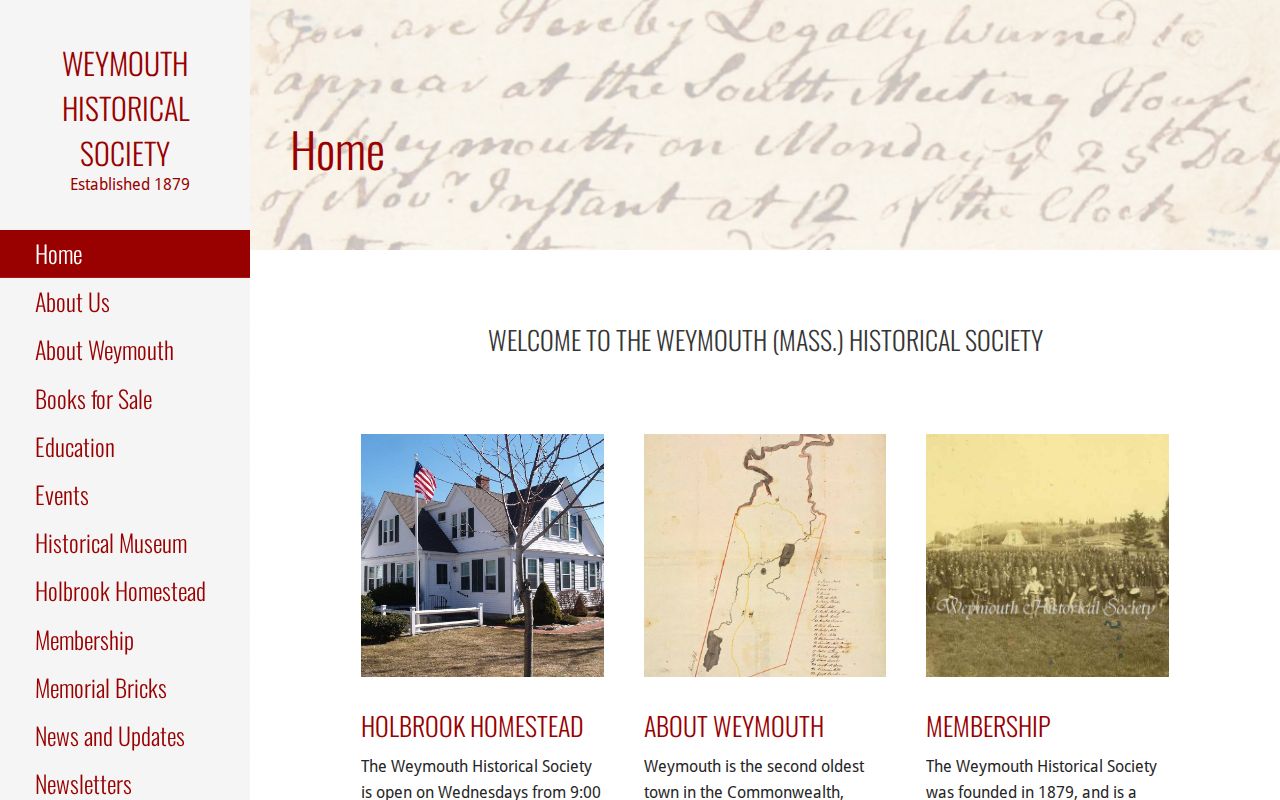
The Society provides a local counterpart to the State Library shelf, especially when a directory surname leads to burial, family, or village-history evidence.
Weymouth Directory Place Names
Place names are a practical search quirk. The 1927 Library of Congress Sanborn edition has 39 sheets and names Eastern Neck, East Weymouth, Lovell’s Corner, Nash’s Corner, North Weymouth, South Weymouth, Weymouth Centre, and Weymouth Heights. The 1899 edition has 20 sheets. Both are public-domain visual sources for building footprint, use, materials, street, and block context, not a list of occupants.
Search old labels alongside a modern street name when an address seems absent. Maps can also help test whether a printed number belongs to the same block. The documented continuity problem is the limited pre-2003 address indexing in land records, not a verified townwide street-renumbering event. Do not invent a renumbering from a mismatch.
Weymouth Directory Digital Trail
Weymouth’s historical access is broader than a shelf of bound books. Boston Public Library digitization and Community Preservation support helped place annual reports, yearbooks, newspaper material, and historic collections online. The Town’s current ARPA project page also lists a paper-record digitization allocation, but it does not identify the record series or a completion date. Treat it as an access initiative, not a promise that a particular directory volume will appear next.
For a carefully documented search, save the collection name, volume year, page image or page number, and the exact spelling printed there. That record of the search makes a later census, Gazette, or deed comparison much easier to check.